Synthetic Opioid key responses
- Mapping evidence-based key responses to synthetic opioids and their implementation strategies
- Field-tested Toolkit with seven implementation guides
Access saves lives: Opioid overdose treatment
To mark International Overdose Awareness Day on 31 August, the IAS is pleased to announce the publication of a new policy brief: “Access saves lives: Opioid overdose treatment.” It outlines the extent of opioid deaths worldwide and how these could be prevented by enhanced and timely access to Naloxone, an effective antidote that reverses an opioid overdose if administered quickly enough.

Guidelines for naloxone provision upon release from prison and other custodial settings
Guidelines for naloxone provision upon release from prison and other custodial settings - a hands-on toolkit for policy makers and practitioners on how to set up and run naloxone programmes for overdose prevention upon release from prison and other custodial settings.
The toolkit aim at providing hands-on recommendations for policy makers and practitioners from prison health services on how to promote, initiate and manage interventions related to overdose prevention through naloxone programs and how to organise related training and capacity building.
Kirsten Horsburgh from the Scottish Drugs Forum, author of the guidelines, analysed information and literature available from a number of European countries as well as relying on the Scottish national naloxone programme experience, with particular reference to interventions focusing on people leaving prison.

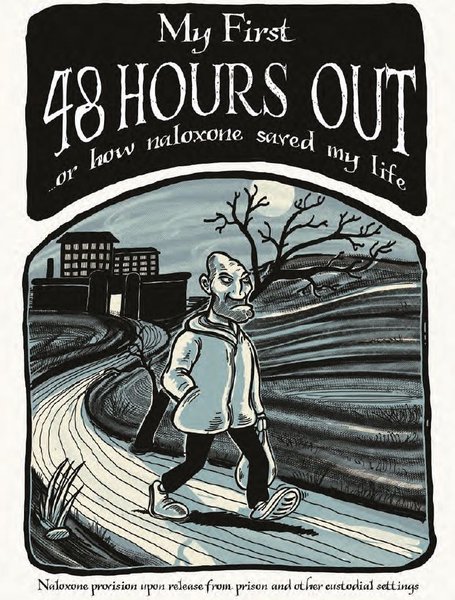
My First 48 Hours Out - visual booklet
This visual booklet was produced in the framework of the EU co-funded project “My first 48 hours out” – comprehensive approaches to pre and post prison release interventions for drug users in the criminal justice system”, implemented by the University of Applied Sciences in Frankfurt.
My first 48 hours out” aims at addressing the gaps in the continuity of care for long-term drug users in prison and upon release, by supporting life-saving interventions for the prevention of overdoses and reduction of other risks related to drug use and for the establishment of a treatment path, which does not get interrupted upon release. The booklet complements the “Guidelines for naloxone provision upon release from prison and other custodial settings”, which were also produced by the project
Effect of Intranasal vs Intramuscular Naloxone on Opioid Overdose. A Randomized Clinical Trial
IMPORTANCE: Previous unblinded clinical trials suggested that the intranasal route of naloxone hydrochloride was inferior to the widely used intramuscular route for the reversal of opioid overdose.
OBJECTIVE: To test whether a dose of naloxone administered intranasally is as effective as the same dose of intramuscularly administered naloxone in reversing opioid overdose.
DESIGN, SETTING, AND PARTICIPANTS: A double-blind, double-dummy randomized clinical trial was conducted at the Uniting Medically Supervised Injecting Centre in Sydney, Australia. Clients of the center were recruited to participate from February 1, 2012, to January 3, 2017. Eligible clients were aged 18 years or older with a history of injecting drug use (n = 197). Intention-to-treat analysis was performed for all participants who received both intranasal and intramuscular modes of treatment (active or placebo).
INTERVENTIONS: Clients were randomized to receive 1 of 2 treatments: (1) intranasal administration of naloxone hydrochloride 800 μg per 1 mL and intramuscular administration of placebo 1 mL or (2) intramuscular administration of naloxone hydrochloride 800 μg per 1 mL and intranasal administration of placebo 1 mL.
MAIN OUTCOMES AND MEASURES: The primary outcome measure was the need for a rescue dose of intramuscular naloxone hydrochloride (800 μg) 10 minutes after the initial treatment. Secondary outcome measures included time to adequate respiratory rate greater than or equal to 10 breaths per minute and time to Glasgow Coma Scale score greater than or equal to 13.
RESULTS: A total of 197 clients (173 [87.8%] male; mean [SD] age, 34.0 [7.82] years) completed the trial, of whom 93 (47.2%) were randomized to intramuscular naloxone dose and 104 (52.8%) to intranasal naloxone dose. Clients randomized to intramuscular naloxone administration were less likely to require a rescue dose of naloxone compared with clients randomized to intranasal naloxone administration (8 [8.6%] vs 24 [23.1%]; odds ratio, 0.35; 95% CI, 0.15-0.66; P = .002). A 65% increase in hazard (hazard ratio, 1.65; 95% CI, 1.21-2.25; P = .002) for time to respiratory rate of at least 10 and an 81% increase in hazard (hazard ratio, 1.81; 95% CI, 1.28-2.56; P = .001) for time to Glasgow Coma Scale score of at least 13 were observed for the group receiving intranasal naloxone compared with the group receiving intramuscular naloxone. No major adverse events were reported for either group.
CONCLUSIONS AND RELEVANCE: This trial showed that intranasally administered naloxone in a supervised injecting facility can reverse opioid overdose but not as efficiently as intramuscularly administered naloxone can, findings that largely replicate those of previous unblinded clinical trials. These results suggest that determining the optimal dose and concentration of intranasal naloxone to respond to opioid overdose in real-world conditions is an international priority.

Street Support - Assesment Report
The European Assessment provides an overview on existing measures to reduce and prevent alcohol and drug related public nuisance. To do so, the assessment combines a qualitative review of scientific and grey literature with expert consultation to which all partners of the project contributed. The Assessment draws attention to the ways in which public space are losing its public function, and the effects it has on people experiencing homelessness and other related marginalized and underserved communities. By identifying the barriers that render these populations vulnerable, and identifying the effects and impact of a selection of inclusive intervention models, the assessment is able to offer recommendations on the level of policy making, service provision, and social life in general.
Street Support - European Report
The European Report provides a critical review of European social policies and policy mechanisms which are relevant for public alcohol and drug-related nuisance, homeless and inclusion, as well as the European drug strategy. Specifically, the European Report presents effective strategies and approaches to foster social integration of people experiencing homelessness and using alcohol and other drugs. Further, it provides a critical review of relevant European social inclusion policies and discusses how these frameworks and mechanisms are relevant for tackling public drugs and or alcohol, as well as consumption in a situation of homelessness.
Street Support - National Report Germany
For the Street Support project, each partner organization complied a Country Report with relevant information regarding the situation on homelessness, alcohol, and drug use in their countries. Complementing this overview, these reports offer an overview of current interventions on national level targeting alcohol and drug-related nuisance, and the impact of those policies, programmes and approaches. Building upon this research, recommendations are offered for the implementation – or further development – or inclusive strategies with the capacity to reduce the so-called public nuisances.
Street Support - National Report Czech Republic
For the Street Support project, each partner organization complied a Country Report with relevant information regarding the situation on homelessness, alcohol, and drug use in their countries. Complementing this overview, these reports offer an overview of current interventions on national level targeting alcohol and drug-related nuisance, and the impact of those policies, programmes and approaches. Building upon this research, recommendations are offered for the implementation – or further development – or inclusive strategies with the capacity to reduce the so-called public nuisances.
Street Support - National Report Netherlands
For the Street Support project, each partner organization complied a Country Report with relevant information regarding the situation on homelessness, alcohol, and drug use in their countries. Complementing this overview, these reports offer an overview of current interventions on national level targeting alcohol and drug-related nuisance, and the impact of those policies, programmes and approaches. Building upon this research, recommendations are offered for the implementation – or further development – or inclusive strategies with the capacity to reduce the so-called public nuisances.
Street Support - National Report Ireland
For the Street Support project, each partner organization complied a Country Report with relevant information regarding the situation on homelessness, alcohol, and drug use in their countries. Complementing this overview, these reports offer an overview of current interventions on national level targeting alcohol and drug-related nuisance, and the impact of those policies, programmes and approaches. Building upon this research, recommendations are offered for the implementation – or further development – or inclusive strategies with the capacity to reduce the so-called public nuisances.