Synthetic Opioid key responses
- Mapping evidence-based key responses to synthetic opioids and their implementation strategies
- Field-tested Toolkit with seven implementation guides
Guidelines and Recommendations (Swedish)
Guidelines and Recommendations for the Implementation of Minimum Quality Standards in Drug Demand Reduction in the European Union by Civil Society Organisations (CSO's)

Guidelines and Recommendations (Slovenian)
Guidelines and Recommendations for the Implementation of Minimum Quality Standards in Drug Demand Reduction in the European Union by Civil Society Organisations (CSO's)
Guidelines and Recommendations (Spanish)
Guidelines and Recommendations for the Implementation of Minimum Quality Standards in Drug Demand Reduction in the European Union by Civil Society Organisations (CSO's)
Guidelines and Recommendations (Hungarian)
Guidelines and Recommendations for the Implementation of Minimum Quality Standards in Drug Demand Reduction in the European Union by Civil Society Organisations (CSO's)
Harm reduction in Europe: a framework for civil society-led monitoring
Rafaella Rigoni , Tuukka Tammi , Daan van der Gouwe , Eberhard Schatz
Background: Civil society organisations (CSOs) play a vital role in developing and implementing efective measures to reduce the harms of drug use. They are also fundamental actors to monitor and evaluate programmes and policies for improvement. While harm reduction services are subject to monitoring, and international and European indicators exist, a framework for civil society-led monitoring does not exist. This paper analyses the challenges and added values of developing such a framework for the European region.
Methods: Since 2018, a technical working group within Correlation-European Harm Reduction Network (C-EHRN) is developing and revising a monitoring framework, collecting—through National Focal Points—the experience of harm reduction service providers and service users in 34 European countries. The frst round of data collection, in 2019, focused on hepatitis C, overdose prevention, new drug trends and civil society involvement in drug policies. Results: Developing CSO-based harm reduction monitoring is a learning by doing process. Assuring reliability and national representativeness of the data was a central challenge. As most CSOs have little or no experience with monitoring and research and work in a local-based context, the monitoring approach and its indicators were adjusted to the local context in the second round, bringing more in-depth information and helping to improve results’ reliability. While this implied shifting from the initial focus on comparing responses at a national level, the change to collecting qualitative data refecting local realities of service policies and delivery provides the foundations for a critical appraisal of these realities against European policy goals. This allowed to map discrepancies between ofcial policies and their implementation, as well as identify gaps in and complement data collection from national-level agencies.
Conclusions: By focusing on local experiences regarding the delivery of global and European policy targets, C-EHRN monitoring uses the unique strengths of its CSOs network and generates information that complements the reporting by other monitoring agencies. Data refecting the CSOs perspective is essential for optimising local planning of service provision and development of efective and respectful drug policies at national and European level. If data quality issues, as well as the sustainability of reporting, are adequately addressed, civil society monitoring can provide excellent added value for the monitoring of harm reduction in Europe.
Keywords: Monitoring and evaluation, Civil society organisations, Harm reduction, Overdose prevention, Europe

The civil society monitoring of hepatitis C response related to the WHO 2030 elimination goals in 35 European countries
M. Maticic , Z. Pirnat , A. Leicht , R. Zimmermann , T. Windelinck , M. Jauffret-Roustide , E. Duffell , T. Tammi , E. Schatz
Background: People who inject drugs (PWID) account for the majority of new cases of hepatitis C virus (HCV) infec‑ tion in Europe; however, HCV testing, and treatment for PWID remain suboptimal. With the advent of direct acting antivirals (DAAs) the World Health Organization (WHO) adopted a strategy to eliminate HCV as public health threat by 2030. To achieve this, key policies for PWID must be implemented and HCV continuum of care needs to be monitored. This study presents results of the frst monitoring led by civil society that provide harm reduction services for PWID.
Methods: In 2019, harm reduction civil society organizations representing focal points of Correlation-European Harm Reduction Network in 36 European countries were invited to complete a 27-item online survey on four strategic felds: use/impact of guidelines on HCV testing and treatment for PWID, availability/functioning of continuum of care, changes compared to the previous year and, the role of harm reduction services and non-governmental organiza‑ tions (NGOs) of PWID. A descriptive analysis of the responses was undertaken.
Results: The response rate was 97.2%. Six countries reported having no guidelines on HCV treatment (17.1%). Twenty-three (65.7%) reported having treatment guidelines with specifc measures for PWID; guidelines that impact on accessibility to HCV testing/treatment and improve access to harm reduction services in 95.6% and 86.3% of them, respectively. DAAs were available in 97.1% of countries; in 26.4% of them they were contraindicated for active drug users. HCV screening/confrmatory tests performed at harm reduction services/community centers, prisons and drug dependence clinics were reported from 80.0%/25.7%, 60.0%/48.6%, and 62.9%/34.3% of countries, respectively. Provision of DAAs at drug dependence clinics and prisons was reported from 34.3 to 42.9% of countries, respectively. Compared to the previous year, HCV awareness campaigns, testing and treatment on service providers’ own locations were reported to increase in 42.9%, 51.4% and 42.9% of countries, respectively. NGOs of PWID conducted awareness campaigns on HCV interventions in 68.9% of countries, and 25.7% of countries had no such support.
Conclusion: Further improvements in continuum-of-care interventions for PWID are needed, which could be achieved by including harm reduction and PWID organizations in strategic planning of testing and treatment and in eforts to monitor progress toward WHO 2030 elimination goal.
Keywords: Hepatitis C, People who inject drugs, Continuum of care, Harm reduction, Civil society, Monitoring
CIVIL SOCIETY MONITORING OF HARM REDUCTION IN EUROPE 2020
Rafaela Rigoni , Tuukka Tammi , Daan van der Gouwe , Victoria Oberzil , Robert Csak , Eberhard Schatz
Please note: there are various version of this report if you click on the file!
This is the second civil society-led monitoring report produced by Correlation – European Harm Reduction Network (C-EHRN). The purpose of this report is to enrich the information and knowledge base of harm reduction interventions in Europe from the viewpoint of civil society organisations. The Monitoring report gathers data on the experiences of harm reduction service providers and service users at ground level, building on a network of national Focal Points (FPs) in Europe. For the 2020 monitoring, C-EHRN includes 35 FPs in 34 countries. To get insight at the implementation level, and to profit from the experiences and expertise of FPs, the 2020 monitoring focuses mostly on cities rather than countries. The main areas monitored are: essential harm reduction services, overdose prevention, Hepatitis C, New drug Trends, Civil Society Involvement and COVID-19 impact on harm reduction services and people who use drugs.
Beyond clinical outcomes: the social and healthcare system implications of hepatitis C treatment
Marta Torrens , Takunbo Soyemi , Darcy Bouwman , Eberhard Schatz
Background: Hepatitis C virus (HCV) infections in people who inject drugs (PWID) can now be treated and cured. However, the impact that HCV treatment has on drug-user health, practices and wellbeing is not known. The aim of this research was to understand the non-clinical impact that HCV treatment has in PWID and their reasons for accessing and completing treatment.
Methods: Participants aged 25–67 years who had injected opioids or stimulants (currently or in the past) and had completed direct-acting antiviral treatment were recruited from seven European countries. Participants completed a 30-min online survey administered face-to-face between September 2018 and April 2019. The questionnaire responses were used to assess the mental and physical impact of having completed treatment.
Results: Of the 124 participants who completed the survey questionnaire, 75% were male, 69% were over 45 years old and 65% were using opioids and/or stimulants at the start of HCV treatment. Participants reported improvements in the following areas after completing HCV treatment: outlook for the future (79%); self-esteem (73%); ability to plan for the future (69%); belief in their abilities (68%); confidence (67%); empowerment (62%); energy levels (59%); and ability to look after themselves (58%). The most common reasons for starting HCV treatment were: becoming aware of treatments that were well tolerated (77%) and effective (75%); and understanding the potentially severe consequences of HCV (75%).
Conclusions: The benefits of HCV treatment go beyond clinical outcomes and are linked to improved drug-user health and wellbeing. Sharing information about well-tolerated and effective HCV treatments, and raising awareness about the potentially severe consequences of untreated HCV are likely to increase the number of PWID who are motivated to access and complete HCV treatment in future.
Keywords: Hepatitis C, Outcomes, Experience, People who inject drugs, Mental health, Physical wellbeing
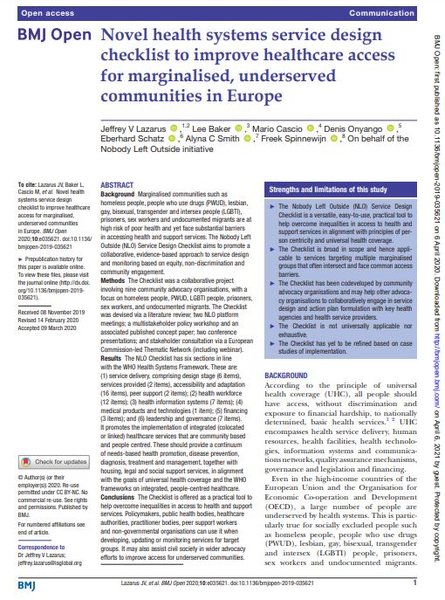
Novel health systems service design checklist to improve healthcare access for marginalised, underserved communities in Europe
Jeffrey V Lazarus , Lee Baker , Mario Cascio , Denis Onyango , Eberhard Schatz , Alyna C Smith , Freek Spinnewijn
Background: Marginalised communities such as homeless people, people who use drugs (PWUD), lesbian, gay, bisexual, transgender and intersex people (LGBTI), prisoners, sex workers and undocumented migrants are at high risk of poor health and yet face substantial barriers in accessing health and support services. The Nobody Left Outside (NLO) Service Design Checklist aims to promote a collaborative, evidence-based approach to service design and monitoring based on equity, non-discrimination and community engagement.
Methods: The Checklist was a collaborative project involving nine community advocacy organisations, with a focus on homeless people, PWUD, LGBTI people, prisoners, sex workers, and undocumented migrants. The Checklist was devised via a literature review; two NLO platform meetings; a multistakeholder policy workshop and an associated published concept paper; two conference presentations; and stakeholder consultation via a European Commission-led Thematic Network (including webinar). Results The NLO Checklist has six sections in line with the WHO Health Systems Framework. These are: (1) service delivery, comprising design stage (6 items), services provided (2 items), accessibility and adaptation (16 items), peer support (2 items); (2) health workforce (12 items); (3) health information systems (7 items); (4) medical products and technologies (1 item); (5) financing (3 items); and (6) leadership and governance (7 items). It promotes the implementation of integrated (colocated or linked) healthcare services that are community based and people centred. These should provide a continuum of needs-based health promotion, disease prevention, diagnosis, treatment and management, together with housing, legal and social support services, in alignment with the goals of universal health coverage and the WHO frameworks on integrated, people-centred healthcare.
Conclusions: The Checklist is offered as a practical tool to help overcome inequalities in access to health and support services. Policymakers, public health bodies, healthcare authorities, practitioner bodies, peer support workers and non-governmental organisations can use it when developing, updating or monitoring services for target groups. It may also assist civil society in wider advocacy efforts to improve access for underserved communities
‘We are still obsessed by this idea of abstinence’: A critical analysis of UK news media representations of proposals to introduce drug consumption rooms in Glasgow, UK
BACKGROUND: Drug consumptions rooms (DCRs) are a well-established and evidence-based harm reduction response to drug use. Recently, a consortium led by health services in Glasgow, United Kingdom (UK), proposed piloting a DCR. In this article, we examine how the proposals were represented in news media reporting, and the possible effects of such reporting.
METHODS: A quantitative content and qualitative thematic analysis of UK news media (n = 174 articles) representations of the proposals to introduce DCRs in the city of Glasgow, UK, was conducted. Analysis was informed by Bacchi’s (2009, 2012, 2017). approach to policy analysis, ‘What's the problem represented to be?’
FINDINGS: Competing representations of the ‘problem’ of injecting drug use (IDU) were contested by a range of actors with different political visions. The applicability of the ‘evidence base’, potential benefits of DCRs to both users and the public, and the associated economic costs, were presented in differing ways depending on the underlying assumptions and presumptions of the arguments constructed (e.g. harm reduction vs recovery). As a result, a number of conflicting subject positions were presented that may have implications for the way that people who inject drugs (PWID) see themselves, and how they are viewed and treated by society. Whilst proponents positioned DCRs within a discourse of public health, an underlying rhetoric of abstinence and recovery underpinned the arguments against DCRs. It was this latter discourse that underpinned the UK Government’s rejection of the proposals, which the Scottish Government were prevented from overruling within the political constraints of their devolved powers, with the lived effect of people who use drugs (PWUD) being denied access to public health services that mitigate harm.
CONCLUSION: We conclude that attempts to introduce and gain public and political support for harm reduction responses such as DCRs through the news media face challenges within the historical and political context of prohibitionist UK drugs policy.