Synthetic Opioid key responses
- Mapping evidence-based key responses to synthetic opioids and their implementation strategies
- Field-tested Toolkit with seven implementation guides
Drug Decriminalization PolicyLiterature Review: Models,Implementation and Outcomes
The prevalence of drug use has increased for decades all around the world despite allthe strict measures taken. The traditional approach creates not only social injusticesat the individual level but also public health problems and high social costs at themacro level. Decriminalization policy has emerged to balance the unresponsiveprohibitionist drug policy. Hence, the primary purpose of this study is to evaluatethe impact of decriminalization policy. The literature reviews are based on reportspublished by governments and NGOs and peer-review articles, as well as criticalresponse papers on the topic. To this end, relevant keywords were used to searchGoogle Scholar and other academic search engines. The results were analyzed toexamine the models, implementation procedures, and as well as the outcomes.

NLO Service Design Checklist
This Checklist is intended for use by service providers and policymakers to design and deliver targeted health and socialservices that are accessible to people in marginalized, underserved communities who are risk at vulnerability, namely: homelesspeople, LGBTI people, people who use drugs, prisoners, sex workers and undocumented migrants.
NLO JOINT STATEMENTImprovinghealthcare accessfor marginalised people
Across Europe, many underserved, marginalised people – including homelesspeople, lesbian, gay, bisexual, transgender and intersex (LGBTI) people,people who use drugs (PWUD), prisoners, sex workers, and people who areundocumented – are at high risk of poor health related to precarious livingconditions and vulnerability.
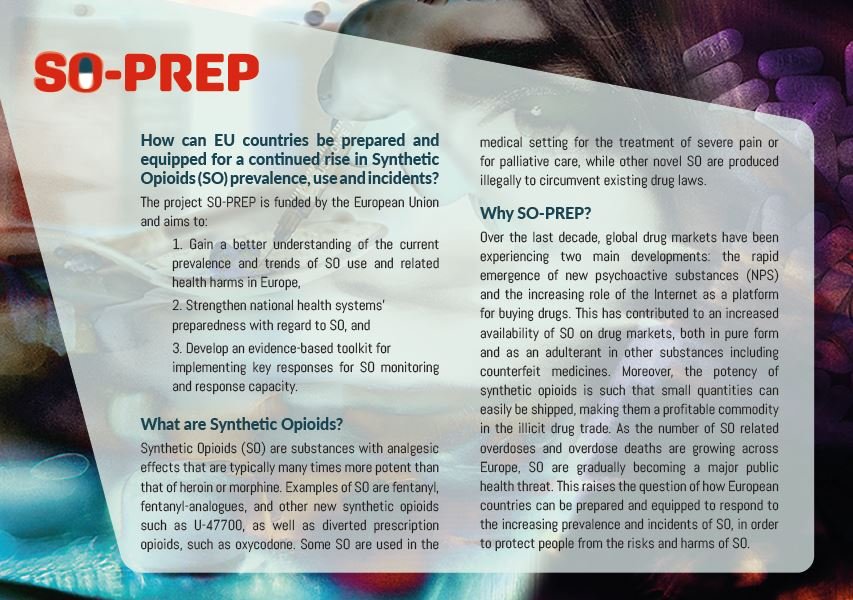
SO-PREP - Project Leaflet
How can EU countries be prepared and equipped for a continued rise in Synthetic Opioids (SO) prevalence, use and incidents?
The project SO-PREP is funded by the European Union and aims to:
- Gain a better understanding of the current prevalence and trends of SO use and related
health harms in Europe, - Strengthen national health systems’ preparedness with regard to SO, and
- Develop an evidence-based toolkit for implementing key responses for SO monitoring and response capacity.

SO-PREP - Project Background and Summary
The aim of the project SO-PREP is to contribute to the enhancement of SO preparedness of countries in Europe to effectively monitor and respond to increases in SO prevalence and incidents.
The objectives are
- To gain a better understanding of the current prevalence and trends of SO use and health harms in Europe,
- To strengthen national health systems’ SO preparedness by developing recommendations on national SO preparedness and response capacity,
- To develop an evidence-based toolkit for implementing key responses for SO monitoring and response capacity.
Guidelines and recommendations on national synthetic opioid preparedness in European countries
Inari Viskari (Finland) , Tuukka Tammi (Finland)
In Europe, highly potent synthetic opioids (SOs) and related overdoses are a growing public health and safety threat. This report provides guidelines and recommendations on preparedness related to synthetic opioids on the following topics:
- Monitoring systems and rapid data collection
- Prevention and health systems' preparedness
- Prevention of illicit use of prescription opioids
- Law enforcement sector and preparedness
- Local early warning systems
Final report on synthetic opioid preparedness
Inari Viskari (Finland) , Tuukka Tammi (Finland)
The opioid epidemic in the United States has resulted in the loss of almost half a million lives since 2000. Unfortunately, it seems that the concerning trend is continuing as more than 100,000 Americans died from drug overdoses in a one-year period ending in April 2021. Moreover, there is a growing concern that similar development might occur in Europe. By the end of 2020 in Europe, the European Monitoring Center for Drugs and Drug Addiction (EMCDDA) had identified around 830 new psychoactive substances (NPS), of which 46 were reported in 2020. The 67 new synthetic opioids were detected between 2009 and 2020, including ten reported the first time in 2020. While synthetic opioids are not the largest group of NPS, they are generally associated with the highest risk of an overdose of all NPS.
Many European countries have also witnessed a steady increase in prescription opioids over the past ten years, causing increasing attention and concern about the misuse of prescription opioids.
Most European countries have not been planning on implementing any special or new methods, operation models, or protocols to prepare for possible increases in the use of synthetic opioids. There are shortcomings in the monitoring, data collection, and early warning systems (particularly in rapid communication) and room for improvement in strengthening strategies to prepare for a potential SO crisis.
NPS represent a challenge to current drug policy models. It is assumed that repressive drug policies may increase the emergence of NPS as they are more challenging to identify and control than "traditional" drugs. NPS, including synthetic opioids (SO), synthetic benzodiazepines, stimulants, cannabinoids, and hallucinogens, are associated with severe acute intoxications and deaths in Europe. Despite a range of new measures being introduced, NPS represents a challenge to current drug policy models.
This report draws together the key findings and conclusions of previous reports on European countries' synthetic opioid preparedness.
Report on EU good practices of generic health emergency preparedness protocols
Inari Viskari , Tuukka Tammi
The aim of this report is to provide an overview of generic national health emergency responses to public health threats and to identify mechanisms that may be applicable to synthetic opioid preparedness. This inventory will enable us to learn from generic health emergency crises, such as food-borne diseases, flew pandemics, and environmental crises, as well as from the health emergency program EU Joint Action SHARP.
Report on good practices of synthetic opioid preparedness, and needs and challenges in EU Member States
Inari Viskari , Tuukka Tammi
The aim of this report is to provide an overview of synthetic opioid preparedness protocols and strategies of different EU Member States and to identify needs and challenges across the EU. This will be done by means of a review of the literature and a questionnaire to the EMCDDA Reitox Focal Points, both investigating existing practices of synthetic opioid preparedness. In addition to that, the findings will be discussed with key experts in the field to identify needs and challenges in synthetic opioid preparedness.
Are we facing an opioid crisis in Europe?
Katia Verhamme - Department of Medical Informatics, Erasmus MC , Arthur Bohnen - Department of General Practice, Erasmus MC
Over the past 15 years, an increasing use of opioids has been reported in the USA and Canada, coinciding with an increase in opioid addiction, opioid-related morbidity, and opioid-related mortality. Indeed, in the USA approximately 130 patients die from an overdose of prescription opioids each day. The opioid epidemic has been well documented in the USA and Canada, but fewer data are available for Europe.